
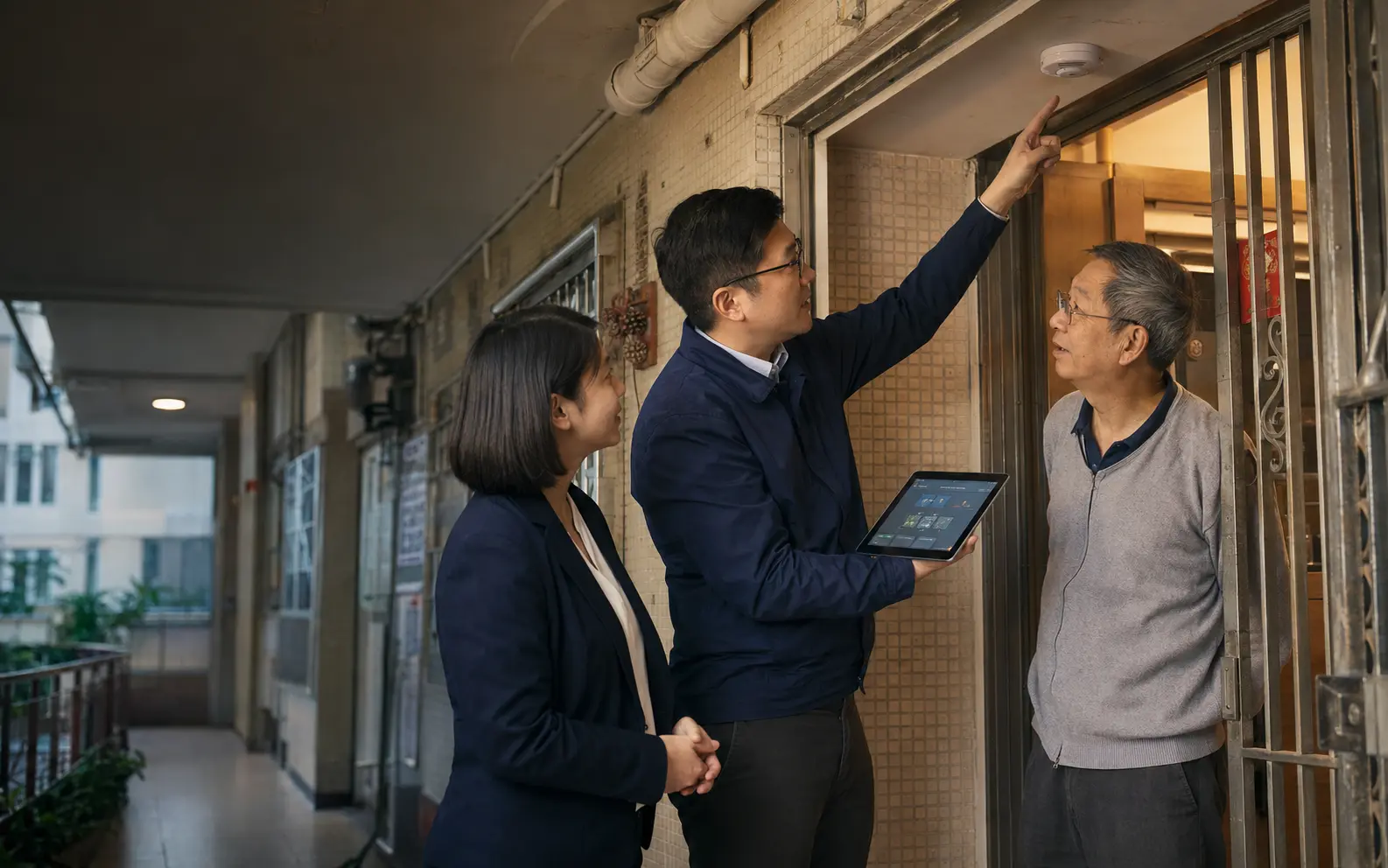
Some target buildings of six storeys or below may use a qualifying IoT FDS under the framework specified by Hong Kong’s Fire Services Department. Every building still requires assessment by qualified professionals against the applicable circular, site conditions and statutory requirements.
Common constraints
Limited space
Plant rooms, tanks, pumps or large hose-reel systems may be constrained by structure and available space.
Distributed units
Common areas and individual premises involve different locations, stakeholders and access arrangements.
Difficult wiring
Extensive cabling may affect residents, common areas and existing finishes.
Reactive maintenance
Battery, offline or fault conditions can remain unseen when management depends only on periodic inspection.
A practical project sequence
- 01
Confirm eligibility
Check use, floor count, existing directions and applicable Fire Services Department requirements.
- 02
Survey and test
Assess device positions, power, gateways, wireless coverage and interference.
- 03
Design resilience
Define sensing, local alarms, gateways, communications, monitoring and backup paths.
- 04
Agree response roles
Specify who receives, acknowledges, escalates and resolves each event.
- 05
Test and maintain
Complete testing, training, device records and ongoing maintenance arrangements.
Important boundary
Acceptance of the IoT FDS system category does not mean every detector, gateway, platform or supplier is automatically approved. Product certification, system acceptance and statutory procedures must be supported by formal project documentation.